
Energy Markets
Everything You Did Not Know About the Energy Markets
Iran Must Be Defeated Once and For All
Of course, the news on most people’s minds the last few days are the goings on in Iran. First let me be very clear, I support Israel. Second, one cannot trust the nation of Iran, who started a war forty-seven years ago on November 4, 1979, and continued that war ever since. Once I heard that American negotiator Steve Witkoff was told last week by his Iranian counterparts that Iran had enough enriched uranium to fuel eleven nuclear bombs, it became clear that they lied again after negotiating a cease fire after the 12-day war (when Carly was running in and out of bomb shelters in Israel while on vacation) and now the US and Israel had no choice but to end the war no matter what it takes.
And Now, the Energy Markets
I have heard from many people in the last few days, who ask: 1) what is going to happen to gas prices and 2) what investments should I make in the energy markets? Furthermore, I must listen to all sorts of people on television – the so called “experts” – who don’t know much about the energy markets. Rather than you light your hair on fire about oil prices or listen to these numbskulls, let me give you a primer on the energy markets.
To begin with, there are two major markets in the energy patch, as we like to call it that matter: crude oil and natural gas, whether drilled for, fracked or extracted from oil sands (primarily Canadian). I am going to focus on crude oil and its main product petroleum or as most people think of it, gasoline.
So, here is what you need to know.
Types of crude oil:
There are two forms of major benchmarks for crude oil: North Sea Brent (Brent) and West Texas Intermediate (WTI). Both are considered light sweet oil. Brent comes from the North Atlantic and WTI from the United States. WTI is slightly lighter and “sweeter” than Brent, making it easier to refine but the main difference is that of geographic origins.
Iran primarily produces medium sour crude oil, with its main export grade known as Iran Light. It also produces heavier sour crude oil. The heavier the crude, the greater its sulfur content. Iran's oil is primarily exported to countries like China, India, and Japan.
Russia produces many grades of crude oil, the predominant one is medium sour. Though the sheer size of Russia makes it host to many varieties of crude oil.
Saudi Arabian crude oil is considered medium sour and thus has sulfur content between light sweet and heavier sour.
The heavier the crude, the more costly and difficult it is to process into commercial fuels. Other factors in the cost of the end product are the length and difficulty in transportation. Hence the importance of WTI for the US and Brent for Europe. Iranian oil is easier to get to market in China, India and Japan.
Crude oil quotation:
Brent Oil and WTI are the two major publicly quoted markets. There are a variety of sources, but the markets are all 24-hour and electronic.
Crude oil is quoted in the futures market, primarily the “Front Month” which is the most actively traded futures contract. The spot market is where you can buy crude oil right now or “on the spot.”
Currently, the price of (as when I wrote this MGF early today) was just over $83 that’s an increase of about 36% from the beginning of the year. WTI is just under $76 an increase of about 32% from the beginning of the year. The spread of the two crude oils is about $7 up from $3 at the beginning of the year.
The price of future contracts is less as you go out to later months. In other words, the markets expect prices to decline in the future.
Producers and refiners will hedge the product in the futures markets, thus making spot prices less important.
Based on everything that I see going on, the real loser in the current markets are Western Europe nations where Brent Prices are on the rise at a faster rate and those nations are likely to not get support from the United States for not supporting the latter’s efforts in Iran.
The industry is largely made up of the following companies:
Upstream – companies involved in the extractive process – i.e. drilling and exploration
Midstream – the pipeline operators, storage facilities and transportation (tankers and rail) companies.
Downstream – the refiners and marketers. Refiners take the raw crude oil and turn it into end products – gasoline, jet fuel, heating oil and chemicals. Marketers are for the most part what you know as gasoline stations.
Integrated – companies that engage in a, b and c above. Exxon (XOM) is the largest example of an integrated oil company
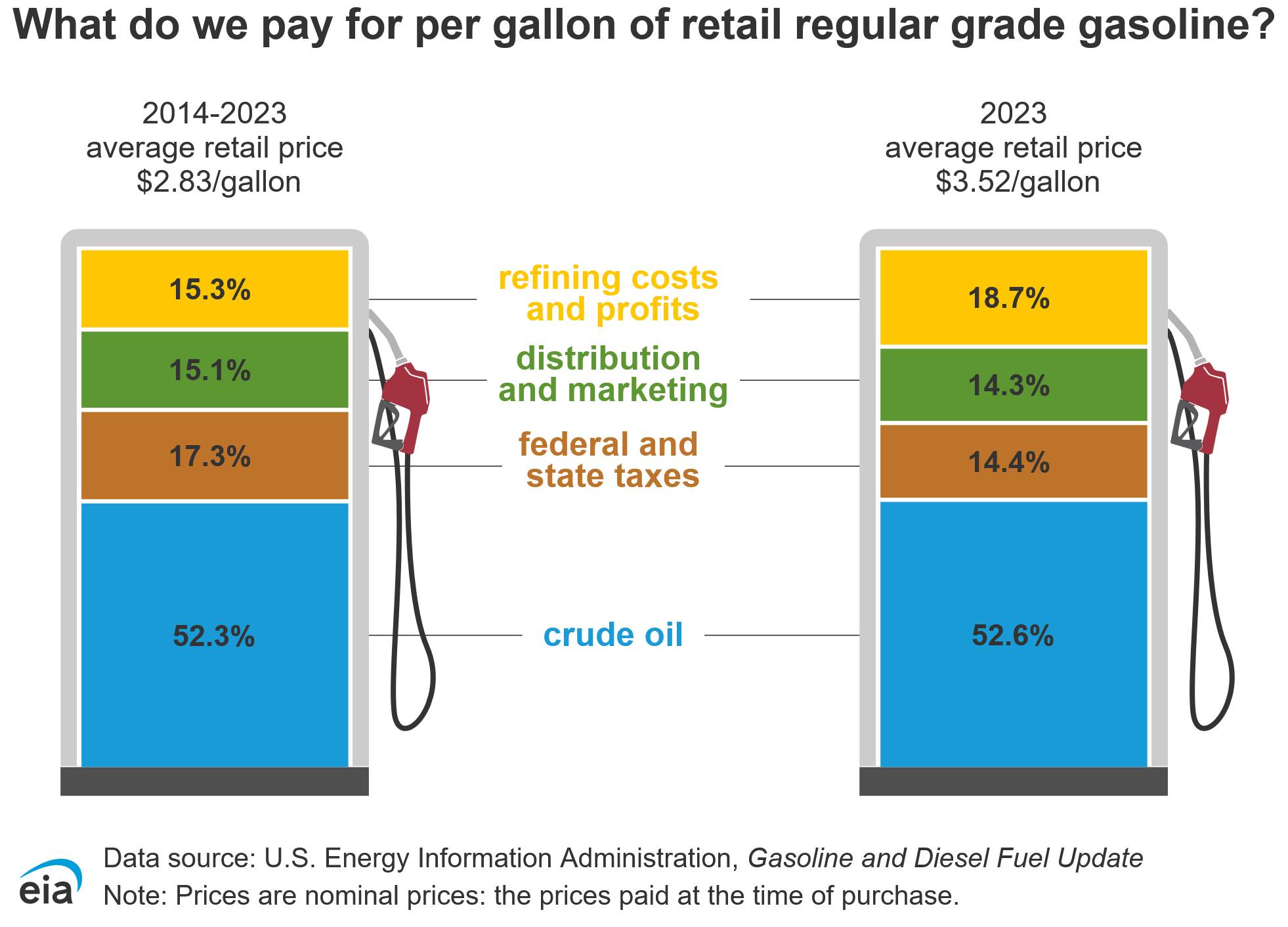
So, what goes into the price of gasoline at the pump? It is best depicted in the chart below which I retrieved from the EIA website(US Energy Information Administration) a source that I have referred to for decades. The chart information was last updated for data through 2023. As you can see, about 53% of the price of gasoline at the pump (on average) is derived from crude oil. So, for every $1 increase in crude oil prices, you can expect about 53 cents to flow to the pump. Government taxes are about 14% of costs, more so in the higher tax states and less so in others. Distribution and marketing, the down streamers, represent another 14%. Finally, the downstream adds close to 19% of your cost. However, the refining costs are heavily reliant on what is called the crack spread – the difference between crude oil and the end refined products – which can vary.
There is no exact conversion from barrels of crude oil to refined gallons of gasoline. It depends on the density of the crude oil. So, just follow the EIA chart as rule of thumb
What Stocks Are Worth Owning?
So, with all that said, what stocks should you buy? If you are new to the energy market, I suggest dipping your toe into the State Street Energy Select Sector SPDR ETF (XLE)of which about 50% is comprised of four stocks: Exxon (XOM), Chevron (CVX), Conoco Phillips (COP) and The Williams Companies (WMB), before you drill down into other stocks in the industry. Energy stocks tend to be good dividends payers. XLE currently yields 2.64% and should go ex-dividend later in March.
Finally, though this is a fictional depiction of the industry, I recommend watching Landman, starring Billy Bob Thornton and Demi Moore.
______________________________________________________________________
Disclosure: At the time of this commentary Richard Siminou, his family and/or clients of Siminou Wealth Management, LLC was long various energy related stocks- although positions can change at any time. The mention of stocks are not recommendations and may not be suitable investments for your individual situation.
Richard Siminou is a financial advisor and founder of Siminou Wealth Management, a fee-only investment advisory and financial planning firm based in New York serving clients nationwide.
If you would like to review your current investment portfolio or discuss retirement, college, tax, or other financial planning considerations, you are welcome to contact us or visithttps://siminouwm.com/
Siminou Wealth Management operates under a fiduciary standard and does not sell proprietary products. Initial consultations are complimentary for prospective clients.
Each client’s financial plan and investment objectives are developed based on their individual circumstances.
This content is for informational purposes only and does not constitute investment advice.
https://www.linkedin.com/in/rsiminou/